

How Recent Attacks on Ukraine’s Energy Infrastructure Are Reshaping Daily Life
As Ukraine endures another wave of large-scale Russian attacks on its energy infrastructure, millions across the country are struggling to maintain access to electricity, heating, and clean water at the height of winter. Nowhere are these hardships more acute than in Kyiv, a city of more than three million people that has once again become a frontline in the battle to preserve essential civil services.
A City Under Pressure
In mid-January, Russia launched one of its most extensive barrages in recent months, striking critical substations, thermal power plants, and heating facilities across the country. These attacks triggered widespread outages of electricity, heating, and water in Kyiv, with damage concentrated particularly on the city’s left bank. Authorities reported that the strikes disrupted supply systems tied directly to the capital’s centralized heating and water infrastructure.
According to Kyiv Mayor Vitali Klitschko, 5,635 apartment buildings—nearly half of the capital’s housing stock—were left without heat following the January 20 attack, marking the second time this winter that such a massive disruption has hit the city. This represents almost 80% of the buildings that had only recently regained heat after the January 9 assault.

These outages don’t simply darken apartments; they paralyze daily life. Residents in affected districts faced significant water shortages, with the entire left bank—particularly the Desnianskyi, Dniprovskyi, and Darnytskyi districts—cut off from water supply. Other areas suffered from critically reduced pressure.
Cold as a Weapon
This winter has brought severe temperatures across Ukraine, with Kyiv experiencing lows of –14°C to –19°C. Under such conditions, the loss of heating quickly becomes life‑threatening. The United Nations has warned that Russia’s repeated strikes during extreme cold place civilians in direct peril and violate international humanitarian law.
Many Kyiv residents have had to improvise. Families heat apartments with gas stoves; others retreat to public shelters, metro stations, or “invincibility points” to warm up and charge essential devices. Some seek refuge in stationary heating trains stationed at local rail hubs—nicknamed “Invincibility Trains”—designed to support civilians during outages. Residents report living without elevators, water, or the ability to cook, forced to carry heavy loads up multiple flights of stairs in freezing stairwells.
A System Near Breaking Point
Experts and government officials warn that Kyiv’s energy infrastructure is nearing exhaustion. Temperatures, ice, and the cumulative effects of near-daily bombardments complicate repairs and weaken the grid’s resilience. According to the Kyiv-based DiXi Group, damage to infrastructure is now two to four times harder to repair due to ice and ongoing attacks.
Despite engineers’ tireless work, emergency power‑off schedules continue citywide. Utility crews operate around the clock, using heavy machinery—and sometimes their bare hands—to locate and repair frost‑bound cables. Ukrainian authorities have declared a nationwide energy emergency as the grid struggles to meet only 60% of demand.
The situation is further strained by Russia’s use of updated tactics in recent missile and drone attacks, including rare hypersonic missiles designed to evade detection. These strikes have specifically targeted substations that support nuclear power plants, adding another layer of risk to the already fragile system.
Humanitarian Response and Resilience
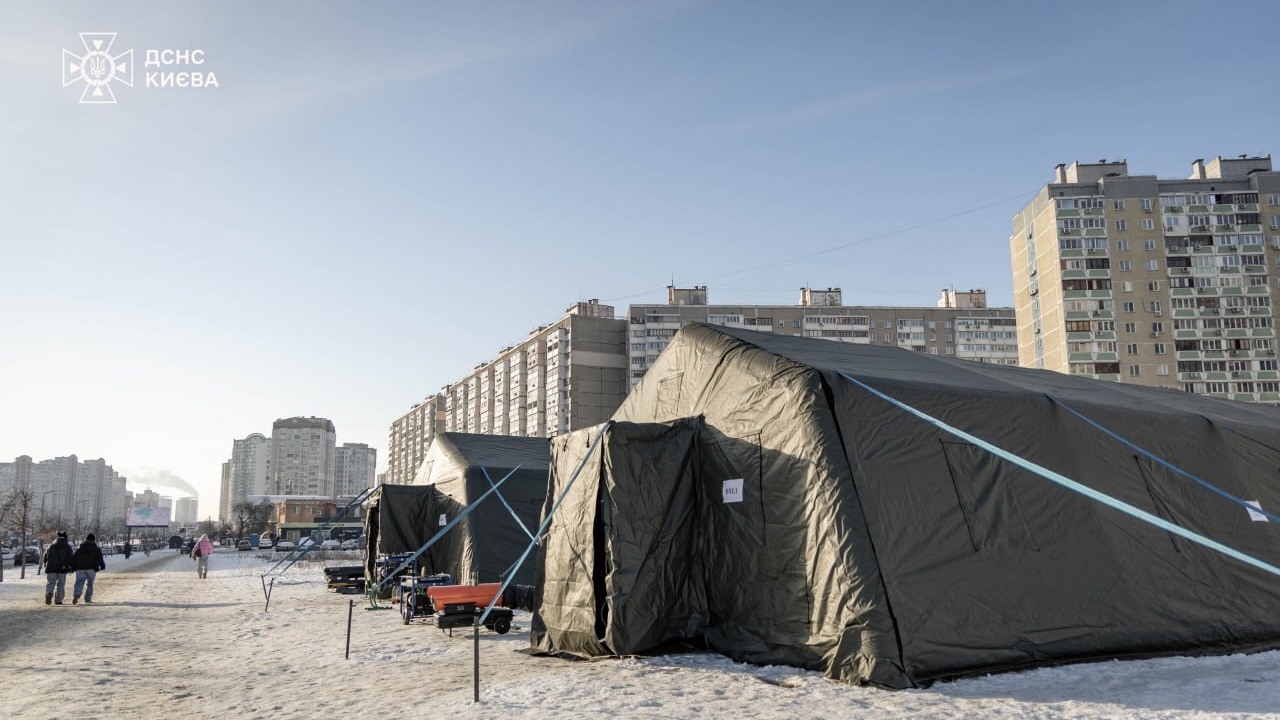
Kyiv’s municipal authorities, together with national energy companies, are working non‑stop to restore services. More than 9,000 residents have already relied on mobile resilience points—heated tents offering warmth, electricity, water, and basic services. The government has also coordinated efforts with international partners to secure additional generators, transformers, and replacement components for damaged facilities.

Despite the adversity, the spirit of Kyiv remains unbroken. Many embassies, foreign missions, and aid organizations have publicly stated they will continue operating in the capital, even without central heating, to show solidarity with the Ukrainian people.
A Test of Endurance
For Kyiv, the current crisis is not merely a technical or logistical challenge—it is an emotional and psychological battle. Each blackout strains morale, disrupts livelihoods, and forces residents to make difficult choices about whether to stay or temporarily relocate. Yet over and over, Kyivans demonstrate resilience, refusing to let darkness become defeat.
As the city continues working to restore essential services, support for Ukraine’s energy sector and civilian infrastructure remains a critical humanitarian priority. Ensuring that families can access heat, water, and electricity during winter is not only vital for survival—it strengthens the country’s resolve at a defining moment in its history.
All photos are made by the State Emergency Service of Ukraine
